
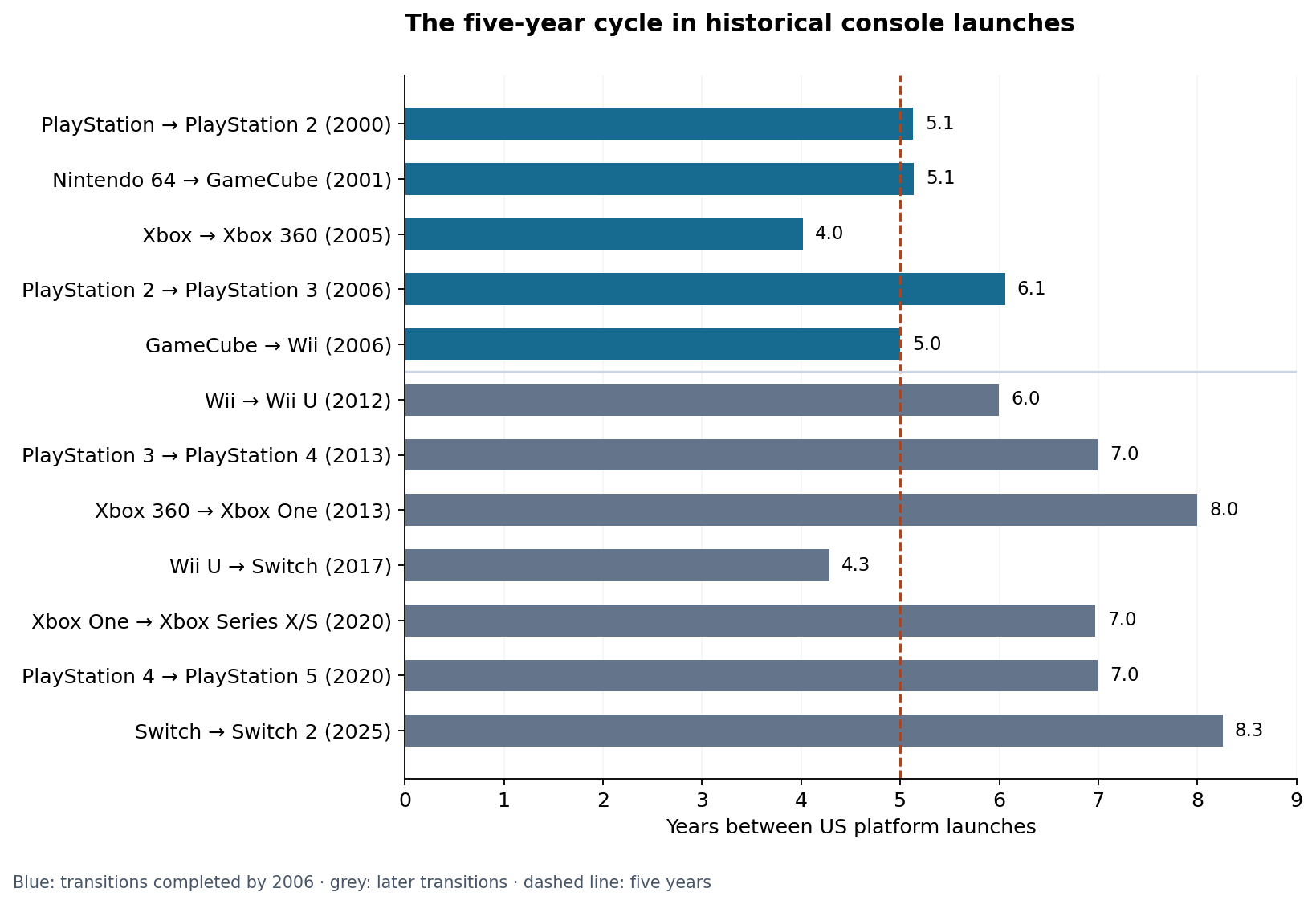
Console generations traditionally followed a roughly five-year hardware cycle. In our Nintendo, Sony and Microsoft chronology, the five successor launches completed by the end of 2006 were 5.1 years apart on average, with a 5.1-year median.
That description also appears in industry reporting. GamesIndustry.biz’s 2016 assessment describes a traditional five-to-six-year cycle and treats the extended Xbox 360/PlayStation 3 era as a departure from it.
| Historical transition | US launch interval |
|---|---|
| PlayStation → PlayStation 2 | 5.1 years |
| Nintendo 64 → GameCube | 5.1 years |
| Xbox → Xbox 360 | 4.0 years |
| PlayStation 2 → PlayStation 3 | 6.1 years |
| GameCube → Wii | 5.0 years |
| Mean / median | 5.1 / 5.1 years |
Regional launch delays do not change that broad result. Using the first release anywhere, rather than the US date, gives a mean of 5.3 years and a median of 5.2. Both describe approximately five years, with individual launches spread around that interval.
The cycle subsequently lengthened. Xbox 360 to Xbox One took eight years; PlayStation 3 to PlayStation 4 took seven. Across all 12 completed intervals through Switch 2 in 2025, the US-date median is 6.0 years. The five-year figure describes the historical convention, not a promise about every generation.
We joined manufacturer launch histories and announcements for 15 platforms. The historical comparison ends with the 2005–06 introductions of Xbox 360, PlayStation 3 and Wii. Slim, Pro and storage revisions are excluded; Xbox Series X/S is one platform. Launch-to-successor gaps measure hardware replacement cadence, while older consoles and their games can remain available into the next generation.
Launch dates and sources · Period comparisons · All intervals · Methods
Research data and calculation scripts, version 3.0 (ZIP, 5 MB). Updated 16 September 2026.