
Improving a white LED’s colour rendering usually carries an efficiency cost. Phosphor mixtures broaden the emitted spectrum so colours look more natural, but some added red light falls where human vision is less sensitive. The result can be fewer visible lumens per watt.
Our catalogue comparison finds that trade-off in 150 of 151 matched 80/90-CRI pairs. We matched colour temperature, current and package within each range, then compared the rated efficacy of the two colour-rendering variants.
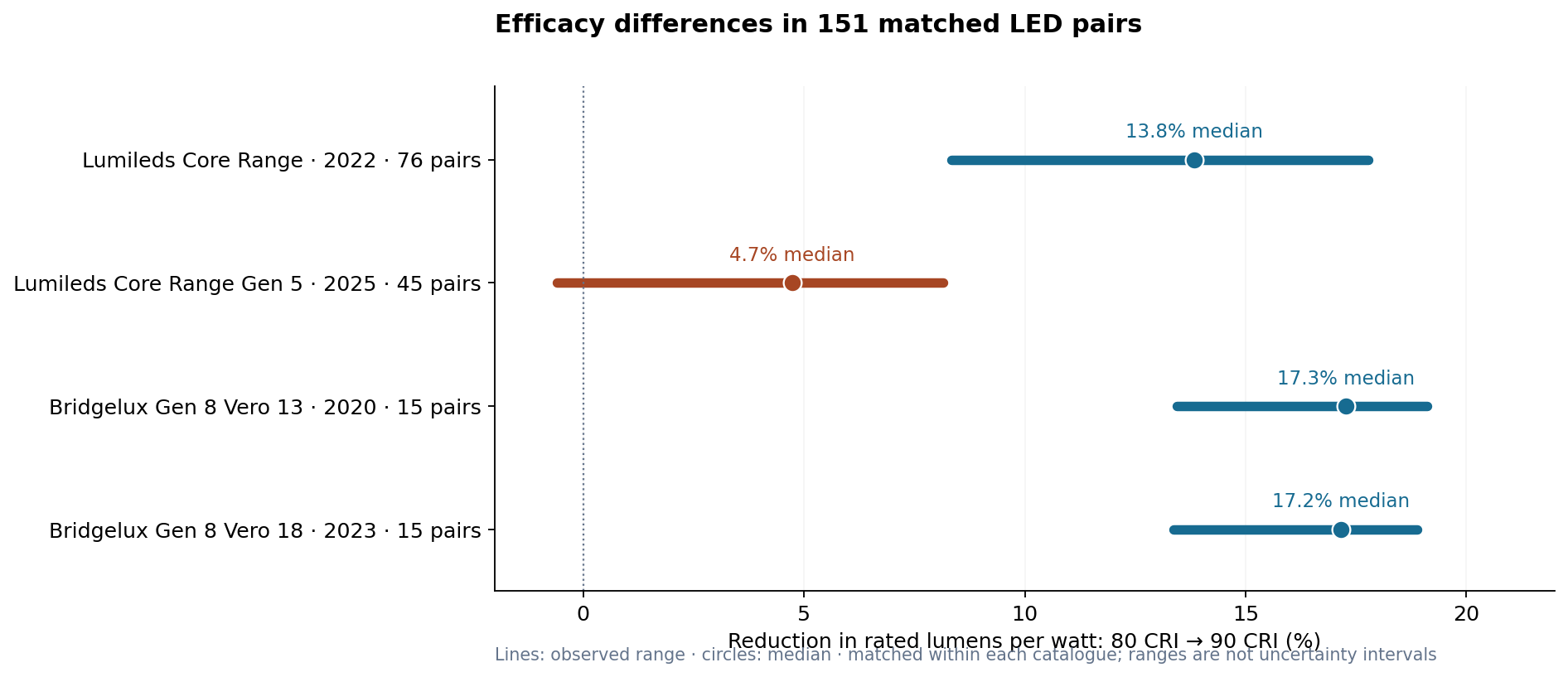
| Catalogue | Matched pairs | Median efficacy reduction |
|---|---|---|
| Lumileds Core Range, 2022 | 76 | 13.8% |
| Lumileds Core Range Gen 5, 2025 | 45 | 4.7% |
| Bridgelux Gen 8 Vero 13, 2020 | 15 | 17.3% |
| Bridgelux Gen 8 Vero 18, 2023 | 15 | 17.2% |
The physical explanation is documented in Lumileds’ phosphor white paper. Narrower red-phosphor emission can reduce the loss, which helps explain why high colour rendering does not imply one fixed efficiency penalty. Nichia and Cree LED describe designs that improve high-CRI efficacy substantially.
For a 3,000 K pair in the newer Lumileds catalogue, efficacy falls from 157 to 150 lm/W, a 4.5% reduction. The sole pair going the other way changes from 165 to 166 lm/W—smaller than the manufacturer’s measurement tolerance. It does not overturn the dominant pattern.
The dataset contains 530 specification rows. Comparisons remain within each catalogue because temperature and measurement conditions differ between manufacturers. Catalogue values are rounded ratings, not our laboratory measurements; the older and newer product mixes also differ. The data quantify the trade-off in these ranges while showing how much its size can change.
151 matched pairs · 530 specifications · Catalogue summaries · Methods
Research data and calculation scripts, version 3.0 (ZIP, 5 MB). Updated 16 September 2026.